Poster Sizes, Paper Weights & Types: The Complete School Reference

Every size a school poster maker prints, every weight on the spec sheet, and the three paper finishes schools actually choose between — one reference card, no guessing.
Last updated: August 2026 • 8 min read
Quick Answer
Standard school poster paper is 24 lb bond, about 4.7 mil thick, supplied on wide-format rolls — most commonly 24 or 36 inches wide — and cut to whatever length the poster needs. The most common finished size for classroom and hallway posters is 24×36 inches; smaller jobs use 11×17 or 18×24, and oversized displays go to 36×48 and beyond. Three paper types cover nearly every school job: matte/standard bond for everyday posters, satin photo paper for richer color, and a coated stock for the most saturated finish. For a full head-to-head on finish, see Satin vs. Matte vs. Glossy Poster Paper; for machine-by-machine roll capacity, see the Poster Paper Weight Guide.
Size, Weight and Type Are Three Different Questions
"What size is poster paper," "how much does it weigh," and "what kind of paper is it" get asked together constantly, but they’re three separate specs. Size is the finished dimension on the wall. Weight (or thickness) is how substantial the sheet feels and how well it resists curling. Type is the finish — matte, satin or coated — and it’s independent of both. A poster maker can cut any of its paper types to any size within the roll’s width, so a school’s real decision is usually two clicks: pick a size, pick a finish.
This page is the reference card for all three, sourced straight from the paper specs on our own product pages — not marketing copy. Beyond the card, it links out to the deeper guides — the complete Best Poster Paper for School Poster Makers buyer’s guide, the finish comparison, and the full machine-by-machine weight and roll data — rather than repeating them.
What Size Are School Posters?
There’s no single "standard" poster size — schools print several standard sizes depending on the job. The one that gets called "standard" most often is 24×36 inches, the most-printed size across PSE schools and the size behind the commonly quoted $1.30-per-poster figure. Here’s the full ladder, smallest to largest — each bar is drawn to scale:
Worksheet and flyer enlargements, small classroom signage, quick single-page jobs.
Anchor charts, word walls and door signage — readable from a few feet away.
The default hallway, classroom and event poster size — readable across a room.
Gym, cafeteria and lobby displays, science-fair boards, awards-night backdrops.
Every size above is a cut length — the limit is the paper roll’s width, not its height. Education Express series machines print 24- and 36-inch-wide rolls; Education Studio series machines add 44- and 64-inch-wide rolls, so length is limited only by how much paper is on the roll. That’s how schools print oversized banners and multi-panel hallway displays well past 36×48 without special equipment.
What Is the Weight of Poster Paper?
Paper weight describes how thick and substantial a sheet feels — heavier stock resists curling and shows less show-through from the print behind it, lighter stock is cheaper and prints faster. Wide-format poster paper is usually rated in pounds (bond weight) or mils (thickness) rather than the gsm rating printed on a ream of office paper. School poster paper for everyday printing typically runs in the 24 lb bond range, with photo-weight stocks measured in mils instead of a bond rating because they’re built differently — coated for photographic color rather than for everyday bond durability.
Weight isn’t the only thing that affects how a poster looks and holds up, though — opacity (how much the print behind it shows through) and roll length (how many posters come off one roll before a change-out) matter just as much for a school planning a budget. All three are on the spec sheet for each of our three paper types below.

School poster printers are roll-fed — the roll's weight and length decide how many posters come off before a change-out.
The 3 Paper Types at a Glance
What kind of paper are posters printed on? Nearly every school poster comes down to one of three finishes. Here’s exactly what’s on the spec sheet for each — weight, opacity and roll length, no marketing language.
| Standard / Matte | Satin Photo | Coated | |
|---|---|---|---|
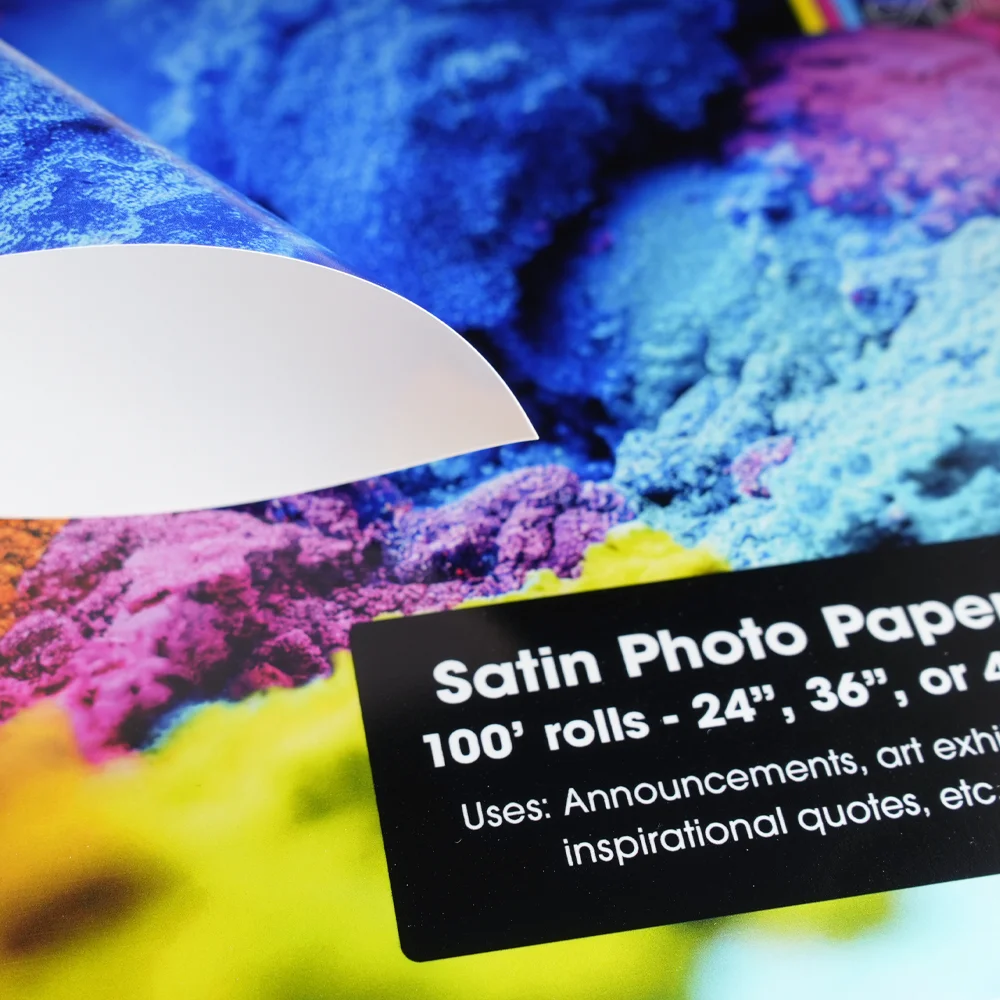
| Finish | Matte, uncoated bond | Satin photo | Chemically coated — our glossiest option |
| Weight / Thickness | 24 lb bond, 4.7 mil | 8 mil | 24 lb bond, 4 mil |
| Opacity | 91% | 96% | 89% |
| Roll Length | 150 ft | 100 ft | 150 ft |
| Best For | Everyday posters, anchor charts, high-volume printing | Photo-quality color, yearbook and gallery displays | Vibrant, saturated color with a protective finish |


A Note on "Glossy" Labeling
Our catalog’s paper-finish attribute only has two formal values, Matte and Satin Photo — there’s no separate "Glossy" attribute anywhere in the system. Coated Poster Paper carries the Matte attribute label too, even though its protective chemical coating and finishing read as the glossiest, highest-sheen option we sell. Treat "coated" as our functional glossy pick by description, not by a formal spec field. For the full satin-vs-matte-vs-glossy decision tree, see the dedicated comparison guide; for weight and roll-capacity mapped to each machine, see the paper weight guide.
Which Size and Finish for Which Job?
24×36, Standard/Matte
The default combination for anchor charts, hallway posters and event signage — the lowest cost-per-poster and the size most schools reorder.
18×24 or 24×36, Satin Photo
Yearbook spreads, gallery walls and award displays where color richness matters more than raw volume.
Any size, Coated
The most vibrant, protected finish we sell — best for posters that get handled, displayed longer, or need to stand out at a distance.
36×48 and up, Studio Series
Gym, cafeteria and lobby-scale work — needs a Studio-series machine’s 44″ or 64″-wide roll capacity.
See Every Size and Finish In Person
Request a free live demo or a same-day quote — every package includes a printed sample so your team can feel the paper before deciding.
Frequently Asked Questions
What size is standard poster paper?
There isn’t one universal "standard" size — wide-format poster paper ships on rolls (commonly 24 or 36 inches wide) and gets cut to whatever length a poster needs. The size most often called "standard" for schools is 24×36 inches; smaller jobs use 11×17 or 18×24, and oversized displays go to 36×48 and beyond.
What is the weight of poster paper?
School poster paper for everyday printing typically runs around 24 lb bond (about 4.7 mil thick). Photo-weight finishes are usually measured in mils rather than a bond rating — our satin photo stock is 8 mil, our coated stock is 24 lb bond at 4 mil. Heavier stock resists curling and shows less show-through; it also affects roll length, since a heavier sheet takes up more of the roll per linear foot.
What are the types of poster paper?
Three finishes cover nearly every school job: standard/matte bond paper for everyday posters and anchor charts, satin photo paper for richer, photo-quality color, and a coated stock — our glossiest, most saturated finish — for posters that need to stand out or get handled more. See the full weight, opacity and roll-length spec table above.
What size are school posters?
Most school posters fall into four common sizes: 11×17 for worksheet enlargements and small signage, 18×24 for anchor charts and classroom posters, 24×36 as the most common hallway/classroom size, and 36×48 for large-format gym, cafeteria and lobby displays. Studio-series machines print roll widths up to 64 inches for anything larger.
What paper do poster printers use?
School wide-format poster printers use roll-fed inkjet paper in one of three finishes — standard/matte bond, satin photo, or a coated stock — supplied on 24-, 36-, 44- or 64-inch-wide rolls depending on the machine. All three are uncoated-to-lightly-coated bond or photo stocks built specifically for wide-format inkjet printing, not the same paper used in a copier or desktop printer.
Size, weight and type are really just three independent settings on the same machine — pick the finished dimension, pick the finish, and any of our paper types can be cut to any size within the roll’s width. To compare every finish we sell — including gloss photo, banner and outdoor media — start with the complete Best Poster Paper for School Poster Makers guide. For the deeper decision between satin, matte and glossy, see the full comparison guide; for weight and roll capacity mapped machine-by-machine, see the paper weight guide; and for real per-poster economics across sizes, see the cost-per-print page.
Written by Elena Alvarez, K-8 library media & makerspace program director for Poster Studio Express.
Last updated: August 2026