Satin vs Matte vs Glossy Poster Paper: The School Buyer’s Guide

Satin vs. Matte vs. Glossy Poster Paper: The School Buyer’s Guide
Three finishes, one poster maker, and a hallway full of expectations. Here’s exactly which finish to load for anchor charts, science fair boards, gym banners, and everything in between — with real specs from our own paper line, not guesswork.
Quick Answer: Satin vs Matte vs Glossy at a Glance
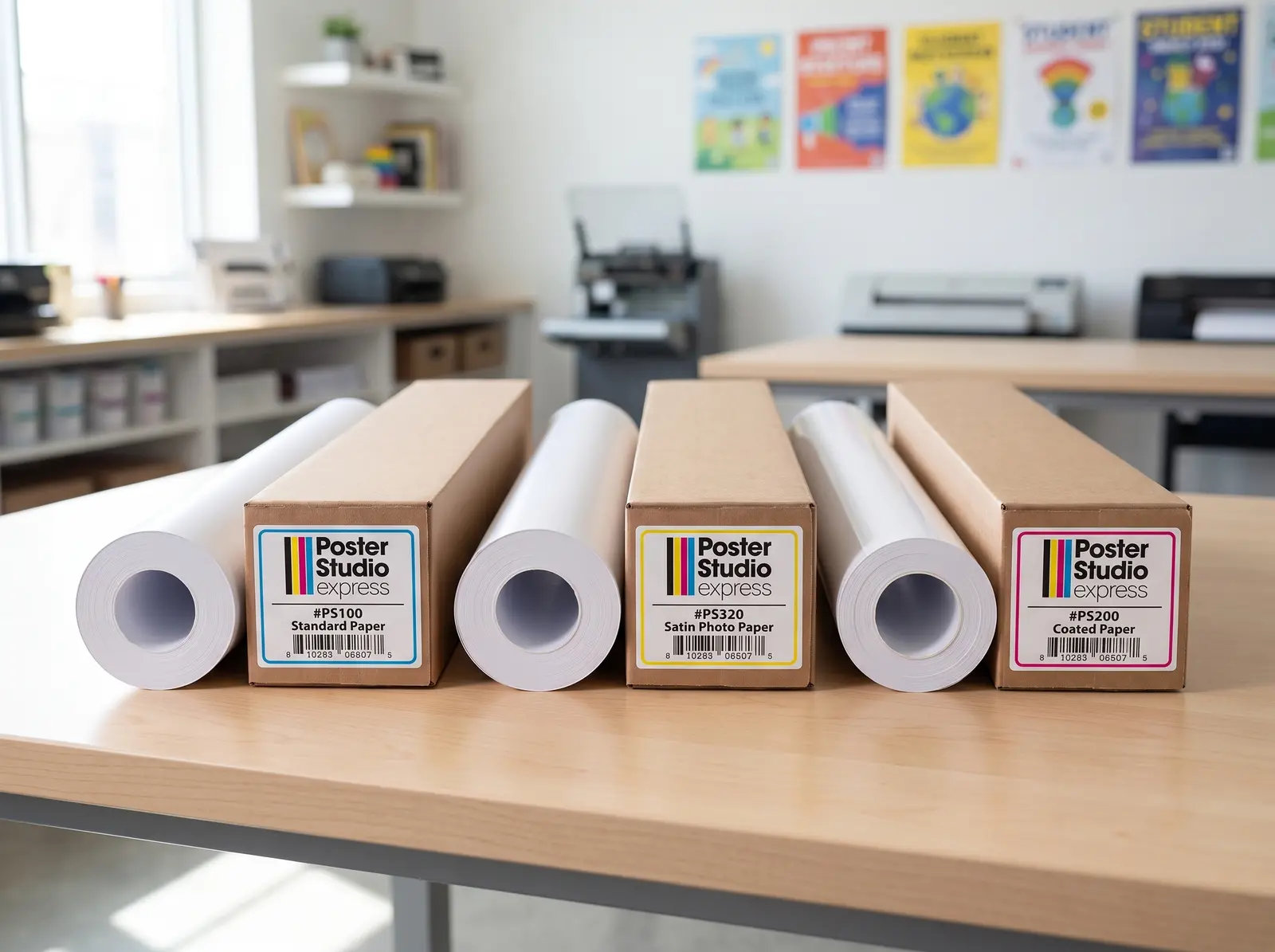
If you only read one section, read this one. Matte is the everyday workhorse (no glare, writes on with dry-erase, cheapest per roll). Glossy (our coated stock) delivers the punchiest color and contrast for anything viewed at a distance. Satin splits the difference — a soft sheen with excellent color depth and almost no glare, which is why it’s the pick school photographers and yearbook advisors reach for first.
What Is Matte Poster Paper?
Matte poster paper has zero surface sheen — light hits it and scatters evenly instead of bouncing back at the viewer. That’s exactly why it’s the default paper loaded in most school poster makers: it reads clearly under fluorescent classroom lighting from any angle, it’s the cheapest finish to keep in stock, and dry-erase or wet-erase markers grip it well enough for reusable charts. Our own Standard Poster Paper is a 24lb uncoated bond stock built for exactly this job.
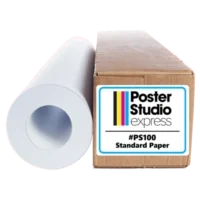
Standard Poster Paper
24lb uncoated bond · 4.7 mil · 91% opacity · 150 ft roll
- No-glare read from any hallway angle
- Lowest cost per poster of the three finishes
- Ideal for lesson planning, graphic organizers, one-time posters
- Works in every Express & Studio series poster maker
Skip matte when: the poster is meant to be photographed for a yearbook or website, or when it’s competing with bright gym or stage lighting from 20+ feet away — that’s where satin or glossy earn their keep.
What Is Satin Poster Paper?
Satin sits between matte and glossy: a soft, pearl-like sheen instead of a flat surface or a mirror shine. It’s the finish most people mean when they ask “what is satin paper for posters?” — a photo-grade stock that boosts color depth and detail well beyond matte, without the harsh glare or fingerprint-magnet surface of true glossy. Our Satin Photo Paper is an instant-dry photo stock that needs no lamination to look finished.
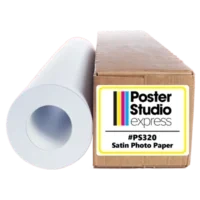
Satin Photo Paper
8 mil · 96% opacity · 100 ft roll · instant-dry
- Reduces glare while still delivering rich, vibrant color
- No lamination needed for a finished, presentation-ready look
- Best opacity of the three finishes — nothing shows through
- Popular for science diagrams, maps, and STEM project displays
Is satin paper glossy or matte? Neither — and that’s the point. Think of it as the paper for anything you want to look polished in a hallway and hold up in a photo: science fair boards, yearbook spreads, banquet signage, retirement/award posters.
What Is Glossy Poster Paper?
Glossy poster paper has a hard, reflective coating that maximizes color saturation and contrast — it’s the finish that makes a poster “pop” from across a gym or auditorium. The tradeoff is glare under overhead lighting and a surface that shows fingerprints more readily than matte or satin. Our closest stock here is Coated Poster Paper, a chemically-coated bond built for detailed, high-contrast prints.
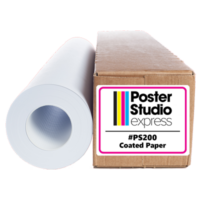
Coated Poster Paper
24lb · 4 mil · 89% opacity · 150 ft roll
- Highest color punch of the three — best for distance viewing
- Protective coating for crisp, detailed line art and photos
- Instant dry with strong ink adhesion straight off the printer
- Built for gym banners, stage backdrops, hallway showcases
Matte vs Glossy: Which Should Your School Choose?
This is the single most-asked paper question we see — and the honest answer is “it depends where the poster hangs.” Here’s the head-to-head.
The Poster Lives in a Classroom
Anchor charts, word walls, PBIS behavior charts, and lesson visuals get viewed up close under classroom lights all day. Matte’s zero-glare surface reads perfectly from every desk angle, and it’s the cheapest finish to reorder every semester.
Verdict: best cost-per-poster for daily classroom use
It Hangs in a Gym or Hallway
Open houses, pep rallies, and hallway showcases are viewed from 15–40 feet under bright overhead lighting. Glossy’s higher contrast and saturation carry across that distance in a way flat matte can’t match.
Verdict: best for distance visibility & visual impact
Matte for Everyday, Glossy for Showcase
Because both rolls run in the same Express & Studio series poster makers, most media centers keep a roll of Standard (matte) loaded for daily classroom output and a roll of Coated (glossy) on hand for open house, fundraisers, and hallway showcases — swapping rolls takes under a minute.
Verdict: no single “winner” — match the finish to where the poster hangs
Satin: The Middle Ground Most Guides Skip
Most “matte vs glossy” articles leave out satin entirely, which is a shame — it quietly solves the exact problem that sends people searching for “matte or matt” in the first place: glare complaints from teachers and low color-depth complaints from parents, in the same poster.
Where satin outperforms both
Science fair display boards, yearbook & photography prints, retirement and award posters, and any poster that will be photographed for a newsletter or social post. Satin’s opacity (96%) is also the highest of the three finishes, so text and images on the back of a poster never ghost through — a common complaint with thinner matte stock on double-sided displays.
For the full breakdown of weights, coatings, and when each paper type earns its keep, see our companion guide: Choosing the Best Paper: Paper Types Explained.
Choosing by Use Case
Skip the theory and match your next print job directly to a finish.
Anchor Charts & Word Walls
Viewed up close, all day, reused for a full unit. Zero glare and marker-friendly matter more than color punch.
Pick: Matte
Science Fair & STEM Boards
Judges and parents view up close and photograph the board — satin’s color depth and high opacity read best in both settings.
Pick: Satin
Gym & Hallway Banners
Pep rallies, sports banners, and stage backdrops are viewed from a distance under bright lighting — glossy’s contrast carries.
Pick: Glossy
Safety & PBIS Signage
Posted in hallways at eye level and referenced daily by students — matte avoids glare from overhead hallway lighting.
Pick: Matte
Yearbook & Media Center Displays
Anything that will also be photographed for a newsletter, yearbook spread, or social post benefits from satin’s balanced sheen.
Pick: Satin
Open House & Fundraiser Displays
First impressions for visiting families and donors — glossy’s vibrancy makes lobby and entryway displays feel premium.
Pick: Glossy
Pricing, Widths & Roll Lengths by Finish
All three finishes run on the same Express and Studio series machines, so switching finishes never means switching hardware — just swapping the roll. Current published pricing by width:
| Finish | 24″ | 36″ | 42″ | 60″ | Roll length |
|---|---|---|---|---|---|
| Matte (Standard) | $59.95 | $69.95 | $89.95 | — | 150 ft |
| Satin (Photo) | $129.95 | $199.95 | $229.95 | $289.95 | 100 ft |
| Glossy (Coated) | $69.95 | $79.95 | $89.95 | $129.95 | 150 ft |
Matte stays the budget default for high-volume, everyday printing — on a poster maker package, in-house prints already run about $1.30 per poster versus roughly $25 through an outside print shop, a 78% savings that compounds fastest on matte’s lower per-roll cost. Satin and glossy cost more per roll but only get pulled out for the posters that need to make an impression, so most media centers keep all three on hand rather than choosing just one.
Not sure which poster maker fits your paper habits? Every Express & Studio series package is built to run matte, satin, and glossy without any settings changes.
Frequently Asked Questions
What is satin paper for posters?
Satin paper is a photo-grade poster stock with a soft, low sheen between flat matte and reflective glossy. It delivers richer color and higher opacity than matte, without the glare or fingerprint-visibility of a true glossy finish. Our version, Satin Photo Paper, is instant-dry and needs no lamination to look presentation-ready. See also our quick FAQ answer on satin paper.
What’s the difference between satin and matte poster paper?
Matte has zero surface sheen and the lowest glare, making it ideal for classroom charts viewed up close under overhead lighting. Satin adds a subtle sheen that boosts color depth and opacity, which is why it’s favored for science fair boards, yearbook spreads, and anything that will also be photographed.
Is satin poster paper glossy or matte?
Neither — satin is its own middle category. It has more sheen and color depth than matte, but far less glare and reflectivity than a true glossy coated stock. That balance is exactly why schools use it for displays that need to look polished in person and in photos.
Matte vs glossy poster paper: which is better for classrooms?
For day-to-day classroom use — anchor charts, word walls, PBIS signage — matte wins because it’s glare-free under fluorescent lighting and the lowest cost per roll. Glossy pulls ahead for posters viewed from a distance in gyms, hallways, or auditoriums, where its higher contrast and color saturation carry better.
Glossy vs matte: which poster paper resists glare best?
Matte resists glare best. Its uncoated, flat surface scatters light evenly instead of reflecting it, so it stays readable under harsh classroom or hallway lighting from almost any viewing angle. Glossy’s reflective coating is what creates its vivid color punch, but that same coating is what causes glare under bright overhead lights.
Is it “matte” or “matt”?
Both spellings refer to the same flat, non-reflective finish — “matte” is the standard spelling in the U.S. print and paper industry (and the one used on our product labels), while “matt” is a common alternate spelling seen more often in British English. There’s no difference in the actual paper finish.
What is glossy poster paper best used for?
Glossy poster paper is best used for posters viewed from a distance where color impact matters most — gym banners, stage backdrops, hallway showcases, and open house or fundraiser displays. Our Coated Poster Paper is the closest match in our lineup, built for crisp, high-contrast prints.
Elena Alvarez
Library Media Specialist · Poster Studio Express · Updated July 2026