






School Poster Printing for Positive Mental Health Messaging

The walls of a school speak volumes. When they speak hope, healing, and acceptance, students listen.
— School Counseling Today
Something remarkable happens when students walk into a space filled with affirming messages. Their shoulders relax. Their breathing slows. They feel seen.
Schools across the country are discovering that poster printing for mental wellness transforms empty hallways into healing environments. These aren't just decorations—they're silent counselors working around the clock, reaching students in moments when no adult can.
And the best part? Creating this therapeutic atmosphere costs less than you'd imagine, especially when you can print exactly what your students need, exactly when they need it.
Three Pillars of Visual Wellness Support
Effective mental health displays work on multiple levels simultaneously. Understanding these pillars helps counselors create displays that truly resonate.
Normalize the Conversation
When mental health messages appear everywhere, students understand that struggling is normal—and asking for help is strength, not weakness.
Provide Practical Tools
Breathing techniques, grounding exercises, and coping strategies displayed visually become accessible resources students can use independently.
Connect to Support
QR codes linking to resources, hotline numbers displayed prominently, and clear pathways to counseling services save lives.
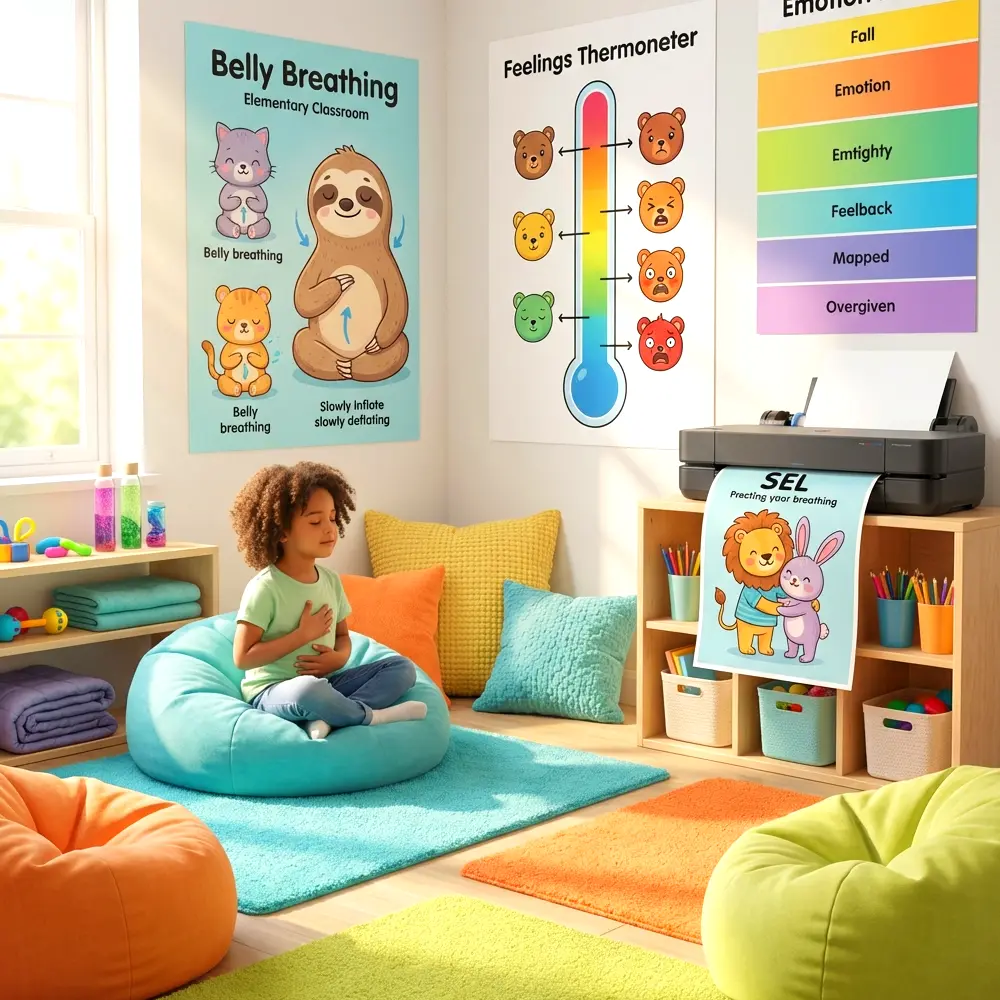
A thoughtfully designed calm-down corner featuring custom-printed SEL visuals, breathing guides, and feelings identification tools—created on-site with a school poster printer.
Why Visual Supports Matter
Research from the Collaborative for Academic, Social, and Emotional Learning (CASEL) confirms what counselors know intuitively: visual cues reduce anxiety, improve emotional regulation, and increase help-seeking behavior. When students see calming imagery and affirming messages repeatedly, neural pathways strengthen.
Imagine every student passing a "Take a breath" poster with simple 4-7-8 breathing instructions. Some will stop. Some will try it. And for the one student in crisis, that single moment of pause might change everything.
Designing for Different Ages
What works for a kindergartener will make a high schooler roll their eyes. Effective mental health displays speak the language of their audience—developmentally appropriate, culturally relevant, and genuinely helpful.
Building Emotional Foundations
Young learners respond to bright colors, friendly characters, and concrete concepts. The Education Express 24" Package A is perfect for classroom calm-down corners.
- Feeling faces with diverse representations
- Animal-themed breathing exercises
- Zones of Regulation color guides
- Problem-solving steps with visuals
- Kindness chain trackers
- Calm-down choice menus
- Mindful moment reminders
- Friendship skill posters
Navigating Complex Emotions
Adolescents need sophisticated messaging that respects their intelligence. Displays should address identity, stress, and peer relationships without being preachy. The Education Studio 36" Package creates impactful hallway displays.
- Test anxiety management techniques
- Social media wellness boundaries
- Conflict resolution flowcharts
- Identity affirmation statements
- Stress response infographics
- Peer pressure response scripts
- Self-care reminder stations
- Growth mindset messages
Real-World Preparation
High schoolers face serious challenges requiring honest, direct messaging. Include local resources, crisis hotlines, and peer testimonials. Rotate displays monthly to address seasonal stressors.
- Depression and anxiety recognition
- Healthy vs. harmful coping strategies
- College application stress relief
- Relationship boundary visuals
- Substance awareness through wellness
- Crisis hotline displays with QR codes
- Future planning stress management
- Peer support connection points
"We started printing wellness posters after a difficult year. Within three months, students were actually referencing the coping strategies they'd seen in the hallways. One student told me the breathing poster outside the testing room 'saved her' during finals. That's when I knew this was worth every penny."
Middle School Counselor
Title I School, Urban District
The Numbers Behind Visual Wellness
Designing for Healing: Best Practices
Creating effective mental wellness displays requires thoughtful design choices. These principles help ensure your messages actually reach students who need them most.
Color Psychology Matters
Blues and greens promote calm and trust. Soft purples encourage creativity and introspection. Warm neutrals feel safe and welcoming. Avoid harsh reds in anxiety-focused displays—they can trigger stress responses.
The premium paper options reproduce colors accurately, ensuring your calming palette translates perfectly to print.
Simplicity Over Complexity
Students in distress can't process cluttered designs. Use generous white space, clear hierarchies, and one key message per poster. If a student can't grasp the message in three seconds, simplify it.
Remember: a struggling student scanning a wall needs instant clarity, not visual puzzles.
Representation and Inclusivity
Students need to see themselves in wellness messaging. Include diverse faces, body types, family structures, and cultural expressions. Translate key messages for multilingual communities.
Generic stock imagery fails—custom designs reflecting your actual student population create genuine connection.
Bridge to Digital Resources
QR codes transform static posters into interactive portals. Link to guided meditations, journaling prompts, counselor scheduling, or crisis text lines. Track scans to understand which resources students actually use.
Pro tip: Use dynamic QR codes that can be updated without reprinting—you can change destinations as needs evolve.
Making It Work on Any Budget
Many counselors assume professional-looking displays require professional budgets. The reality? In-house poster printing costs pennies compared to commercial alternatives—and gives you complete creative control.
Cost Comparison Reality
Commercial mental health posters typically cost $15-30 each and often miss the mark culturally or developmentally. With a school poster printing package, you'll spend approximately $1.30-1.50 per custom poster—designed specifically for your students, printed in minutes, and replaced whenever needed.
Funding Sources to Explore
Mental health initiatives increasingly qualify for dedicated funding. The Substance Abuse and Mental Health Services Administration (SAMHSA) offers school-based mental health grants that can cover equipment costs. Additionally, check our funding resources page for state-specific opportunities.
Stretching Your Investment
Partner with art classes for student-designed wellness campaigns. Coordinate with PE, library, and administration to share equipment costs across departments. Train student wellness ambassadors in basic design—they understand peer messaging better than any adult could.
Every Empty Wall Is a Missed Opportunity
Your students are walking past blank spaces that could be speaking hope, offering tools, and connecting them to help. The question isn't whether visual wellness displays work—the research is clear. The question is how quickly you can transform your school environment.
Mental wellness isn't just a counseling department concern—it's a whole-school responsibility. When every hallway, every classroom, and every common space reinforces messages of hope and healing, students internalize something profound: this community cares about their wellbeing.
Visual displays can't replace trained counselors. They won't solve the youth mental health crisis alone. But they create an environment where struggling students feel less alone, where help-seeking becomes normalized, and where every child encounters compassion dozens of times each day.
That's the power of intentional design. That's what a quality poster printing system makes possible—not just printing, but healing. Not just displays, but daily reminders that every student matters.
Start with one corner. One hallway. One calm-down space. Watch what happens when students begin noticing. Listen to what they say. And then imagine what becomes possible when your entire building speaks the language of wellness.
Because sometimes, the most powerful therapy happens in the spaces between words.