





Boosting Executive Function Skills with a School Poster Maker

Executive function skills form the invisible foundation of student success, yet teaching them often feels like adding another impossible task to an already overflowing plate. What if your existing classroom visuals could seamlessly embed these crucial skills? With a strategic approach to your school poster maker executive function system, you can transform everyday displays into powerful cognitive scaffolds that work continuously without requiring additional instruction time.
Understanding Executive Function Through Visual Systems
Executive function encompasses the mental skills that include working memory, flexible thinking, and self-control. These skills enable students to plan, focus attention, remember instructions, and juggle multiple tasks successfully. Research from the Center for the Developing Child at Harvard University shows that executive function skills predict academic achievement more reliably than IQ scores (Harvard Center on the Developing Child, 2024).
Traditional approaches to teaching these skills often require dedicated lessons, special programs, or individual interventions. However, environmental design offers a more sustainable solution. By embedding executive function supports into classroom visuals, we create what researchers call “distributed cognition” – where the environment itself carries part of the cognitive load.
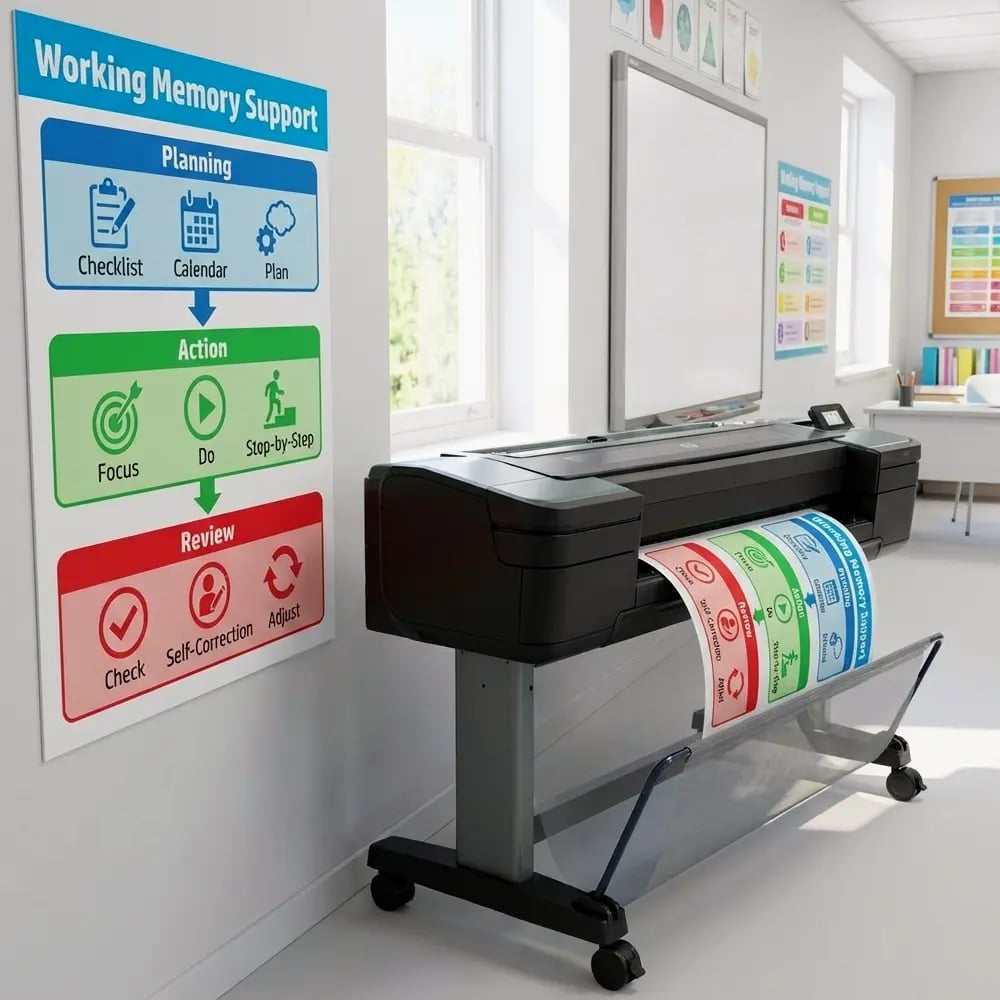
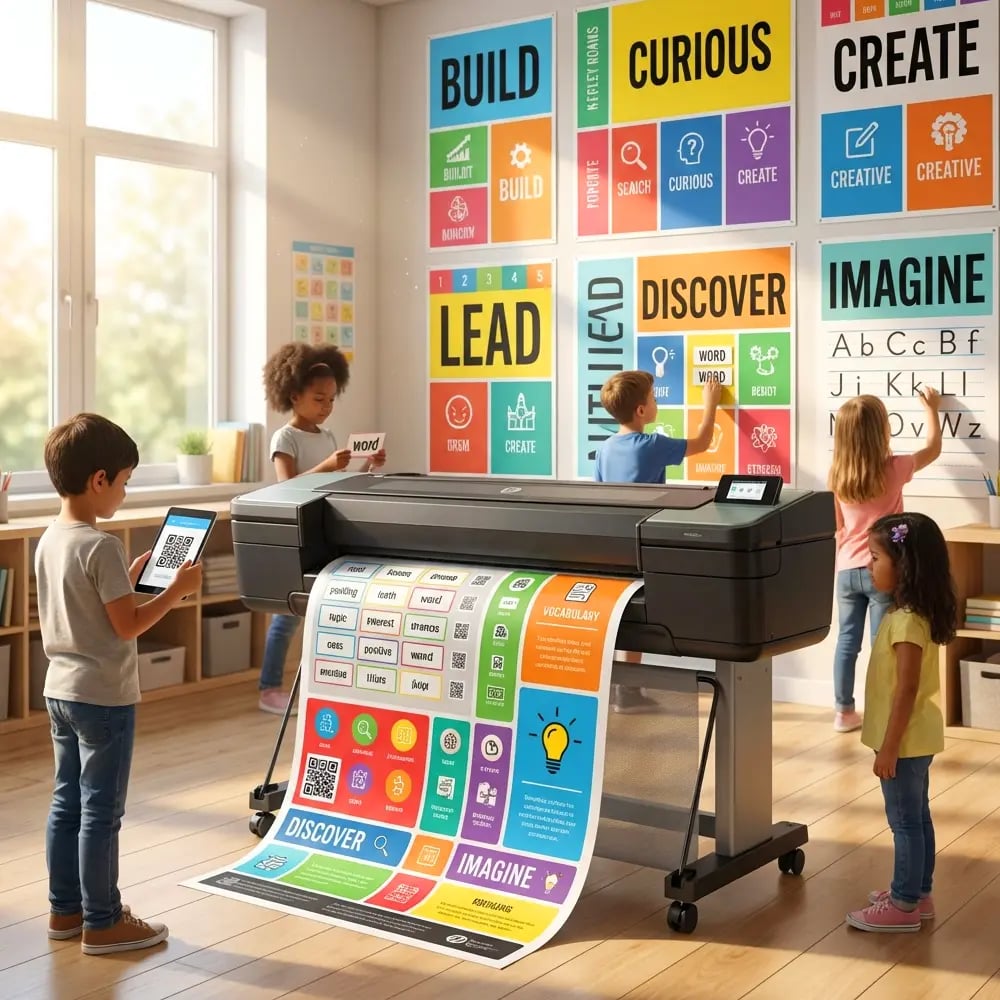
A school poster maker prints a vibrant working memory support chart.
The beauty of this approach lies in its efficiency. Rather than adding to teacher workload, it leverages existing display spaces to provide continuous, implicit instruction. Students absorb organizational strategies, time management techniques, and self-regulation cues through repeated exposure to well-designed visual systems.
Designing Your School Poster Maker Executive Function Toolkit
Creating effective executive function posters requires understanding both the cognitive science behind these skills and the practical constraints of classroom implementation. The key is designing visuals that work on multiple levels – attractive enough to engage students, clear enough to provide immediate utility, and sophisticated enough to support skill development over time.
Working Memory Support Systems
Working memory limitations often manifest as forgotten instructions, missed steps in procedures, or difficulty tracking multi-part assignments. Visual supports can externalize this cognitive load, freeing mental resources for higher-level thinking.
Consider implementing a “Process Anchor Chart” system. These posters break complex procedures into visual chunks, using consistent color coding and iconography. For instance, a writing process poster might use:
- Blue icons for planning stages
- Green for drafting activities
- Orange for revision steps
- Purple for editing tasks
This color consistency across subjects helps students develop mental models for process management. When considering poster printer cost, remember that investing in durable, high-quality prints ensures these foundational tools remain effective throughout the school year. Products like the Education Express 24″ Poster Maker Package A include everything needed to create professional-grade visual supports that withstand daily use.
Time Management Visualization Strategies
Time blindness – difficulty perceiving the passage of time – affects many students, particularly those with ADHD or executive function challenges. Visual time management systems make abstract temporal concepts concrete and manageable.
Design “Time Mapping” posters that visualize common classroom activities with proportional time blocks. Use analog clock faces showing start and end times, paired with visual timers or progress bars. This dual representation helps students develop internal time awareness while providing external structure.
Weekly planning grids offer another powerful tool. Create poster templates showing the week’s structure with color-coded subject blocks, transition times clearly marked, and space for students to add personal reminders. The Lifetime Design Service can help customize these templates to match your specific schedule and student needs.
Implementation Without Instruction: The Zero-Addition Approach
The genius of embedded executive function support lies in its passive instruction model. These posters teach through proximity and repetition rather than explicit lessons. This approach respects teacher time while maximizing student exposure to helpful strategies.
Strategic Placement for Maximum Impact
Position working memory supports near task initiation points. Place writing process charts above computer stations or near writing centers. Install time management visuals where students naturally check schedules – near the classroom door, above assignment collection areas, or beside the daily agenda.
Self-regulation posters work best in transition zones. Mount emotional regulation strategies near the classroom entrance, where students can access them during heightened emotional states. Place focus strategies near individual work areas where students need concentration support.
Poster Systems for School Poster Maker Executive Function Success
Creating cohesive poster systems requires thoughtful planning. Each visual element should connect to others through consistent design language, creating a unified cognitive support network. This systematic approach transforms random classroom decorations into an intentional executive function curriculum.
Start with core templates that address universal executive function needs:
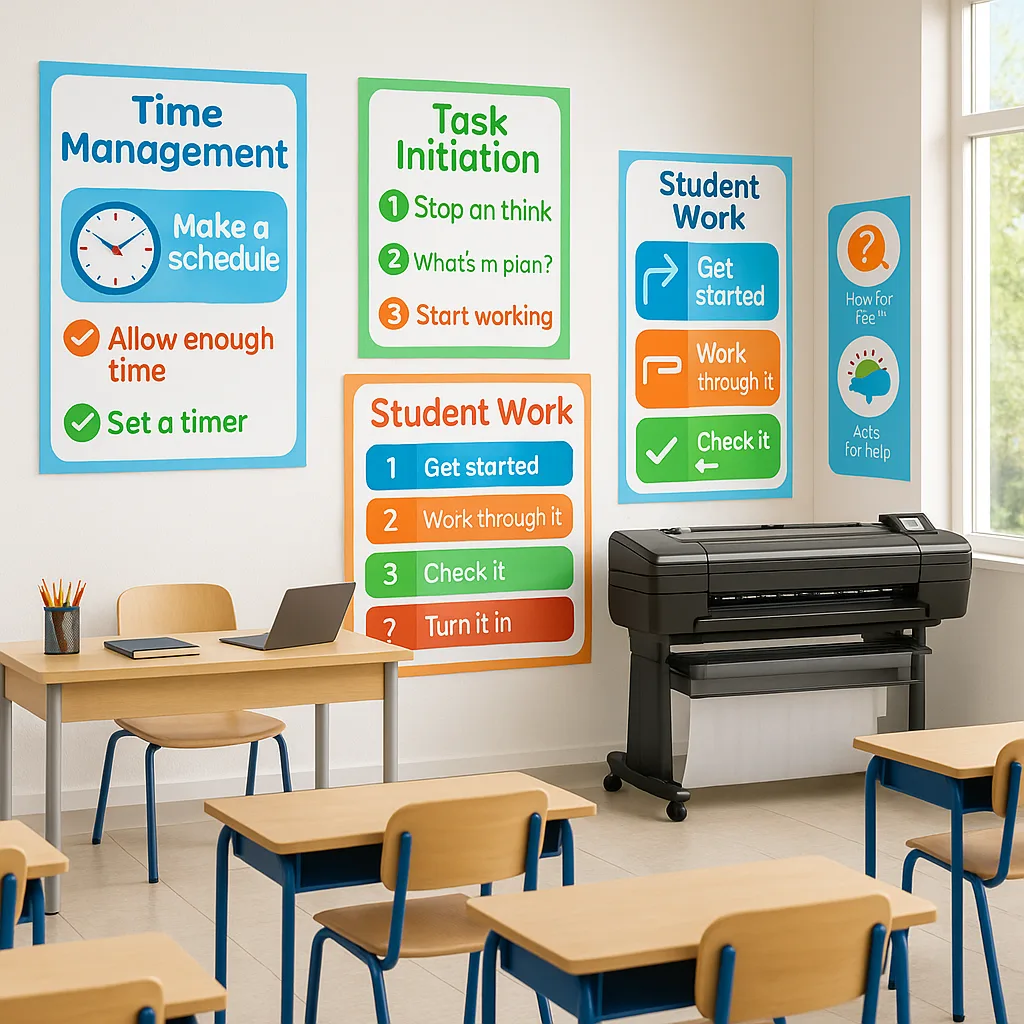
- Task Initiation Posters: Visual flowcharts showing how to begin various assignment types
- Organization Matrices: Color-coded systems for materials management and workspace organization
- Flexibility Frameworks: Visual guides for adapting to schedule changes or unexpected challenges
- Goal-Setting Graphics: Templates for breaking large projects into manageable steps
Ready-to-Print Executive Function Templates
Implementing these strategies doesn’t require extensive design skills. The following templates can be adapted for immediate classroom use, considering reasonable poster printer cost per print (typically $1.30-$1.50 with quality equipment).
The Universal Task Analyzer
This poster template helps students break any assignment into executable steps. The design uses a circular flow diagram with decision points, encouraging students to identify task components systematically. Key elements include:
- Central hub asking “What kind of task is this?”
- Radiating branches for different task types (research, creative, practice, assessment)
- Step-by-step breakdowns specific to each category
- Time estimation guides for each step
- Material checklists integrated into the design
The Emotion-Action Bridge
Self-regulation begins with emotional awareness. This poster design connects feeling identification to appropriate action strategies. The visual metaphor of a bridge helps students understand emotions as temporary states requiring specific crossing strategies.
Design elements include:
- Emotion identification wheel with facial expressions and body language cues
- Color-coded intensity levels from calm to crisis
- Corresponding coping strategies matched to each intensity level
- Quick-reference icons for immediate strategy selection
- Positive self-talk examples integrated throughout
Measuring Impact Without Additional Assessment
The effectiveness of executive function poster systems reveals itself through observable classroom changes rather than formal assessments. Teachers report decreased repetition of instructions, improved assignment completion rates, and reduced anxiety during transitions.
Student behaviors indicating successful implementation include:
- Spontaneous reference to posted strategies during work time
- Peer coaching using poster language and concepts
- Improved time estimation for task completion
- Decreased requests for instruction repetition
- More organized work spaces and materials
These outcomes emerge naturally when visual supports effectively externalize executive function demands. The Education Studio 36″ Poster Maker Package A+ provides the durability and print quality necessary for these high-use classroom tools, ensuring your investment in executive function support maintains its effectiveness throughout the academic year.
Customization for Diverse Learning Needs
While universal design principles guide initial poster creation, customization ensures all students can access executive function supports. Consider creating variations that address specific learning profiles while maintaining visual consistency.
For students with language-based learning differences, emphasize visual symbols and minimize text. Use consistent iconography across all posters, creating a visual vocabulary that transcends reading ability. The cost-effective printing available through quality poster systems makes producing multiple versions financially feasible.
Students with attention challenges benefit from high-contrast designs with clear visual hierarchy. Use bold borders to separate information chunks and employ strategic white space to prevent visual overwhelm. Motion-implying graphics (arrows, flowing lines) can help maintain visual attention while guiding students through processes.
Building School-Wide Executive Function Culture
When multiple classrooms adopt consistent executive function poster systems, the impact multiplies. Students encounter familiar visual supports across environments, reinforcing skill development through repetition and transfer.
Consider establishing grade-level or school-wide design standards:
- Consistent color coding for subject areas or skill categories
- Shared iconography for common processes
- Aligned terminology across grade levels
- Progressive complexity as students advance
This systematic approach transforms individual classroom supports into a comprehensive executive function curriculum embedded within the school environment. The minimal poster printer cost compared to specialized intervention programs makes this approach both pedagogically sound and economically sustainable.
Sustaining Your Executive Function Poster System
Creating lasting impact requires planning for system maintenance and evolution. Unlike static decorations, executive function posters should respond to student growth and changing needs throughout the school year.
Establish quarterly review cycles where you assess poster effectiveness through simple observation protocols. Which posters do students reference most frequently? What executive function challenges persist despite current supports? This reflective practice ensures your visual system remains responsive to actual student needs.
The 5-year warranty on quality poster-making equipment ensures you can update and refine your executive function supports as needed without worrying about equipment failure or replacement costs.
Conclusion: Invisible Teaching for Visible Results
Embedding executive function instruction into classroom visuals represents a paradigm shift in special education and universal design. Rather than adding another curriculum or intervention program, this approach leverages existing environmental features to provide continuous, implicit skill development.
By transforming your school poster maker executive function approach from decorative to instructional, you create classrooms where cognitive support is omnipresent yet unobtrusive. Students develop crucial life skills through environmental interaction rather than direct instruction, preserving precious teaching time for content delivery while ensuring no student lacks access to executive function support.
The initial investment in quality poster-making capability pays dividends through improved student independence, reduced behavioral challenges, and enhanced academic achievement. More importantly, it demonstrates that effective special education support doesn’t always require additional resources – sometimes it simply requires reimagining how we use the tools already at our disposal.
Ready to transform your classroom visuals into executive function support systems? Contact Poster Studio Express at 866-788-7900 to explore how their comprehensive poster-making solutions can help you create the cognitive scaffolds your students need to succeed.